
Nobody saw March 2026 coming quite like that.
Three algorithm updates in six weeks. A spam update that wrapped up in under 20 hours. Then a core update two days later that shook rankings across pretty much every industry you can name. SEMrush Sensor hit 9.5 out of 10 on the volatility scale. Some sites lost a third of their organic traffic in a single week.
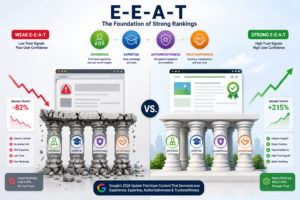
And the common thread running through almost every site that took a serious hit? Weak E-E-A-T signals.
Not technical errors. Not penalty flags. Just content that Google no longer felt confident putting in front of people.
This Is Not a New Concept. So Why Are So Many Sites Still Getting It Wrong?
E-E-A-T, which stands for Experience, Expertise, Authoritativeness, and Trustworthiness, has been part of Google’s quality evaluator guidelines for years. The extra E for Experience got added in 2022. Everyone in the SEO world wrote about it. Agencies put it in their decks. Clients nodded along.
And then a huge chunk of the web just… kept doing the same things.
Generic author bios with no real credentials. Blog content that reads fine but adds nothing original to the conversation. Sites covering twenty different topics because the keyword research said they should. AI-generated content published at volume with zero editorial oversight and zero expertise attached to it.
For a while, that worked well enough. Rankings held. Traffic came in. Nobody panicked.
The March 2026 updates changed that calculation pretty significantly.
What Google Actually Re-Weighted This Time
Here is what the ranking data across hundreds of monitored sites started showing within the first week of the core update rolling out.
Content attributed to real, verifiable people with actual credentials started pulling ahead. Not just ranking better on individual pages, but the domains themselves gained compounding authority. Meanwhile, content sitting under anonymous bylines or generic team profiles started quietly slipping down the results page.
For YMYL content specifically, the stuff covering health, money, legal topics, safety, 73% of top-ranking pages now carry clear author credentials. A year ago that number was significantly lower. That shift happened fast.
Topical depth started beating topical breadth in a way that was hard to ignore. A focused site that covers one subject from every possible angle is now outperforming a broad publisher that touches everything at surface level. Google is essentially treating those focused sites as the reference point for their subject. New pages they publish rank faster. Older pages hold better. It compounds.
And the AI content situation became a lot more nuanced. Look, nobody serious in SEO is arguing that AI writing tools are evil. That is a silly debate. The actual issue is using AI as a replacement for human expertise rather than a tool to support it. Sites where real subject matter experts shape the content, put their name on it, and bring something genuinely original to it are doing fine. Sites that are just hitting publish on AI output at scale are the ones that got caught.
Let Me Tell You What Weak E-E-A-T Actually Looks Like in Practice
Because sometimes it helps to just call it out plainly.
Your author page is a name, a stock photo, and two sentences that could apply to literally anyone. Your content makes claims but cites nothing. Your About page is three paragraphs of vague mission statement language with no information about who actually works there. Your contact page has a form and nothing else. Your blog covers SEO one week, interior design the next, and cryptocurrency the week after because those keywords looked good in the research tool.
None of these things individually is a death sentence. All of them together paint a picture that Google’s systems in 2026 are reading very clearly.
And here is the part that stings a little. You might have great products, genuine expertise in your field, and real value to offer customers. But if your website does not communicate that in ways Google can actually measure, it does not matter. The ranking system cannot read your mind. It reads your signals.
What to Actually Fix and in What Order
Author information comes first. Real names, real photos, real professional backgrounds. Years of experience, specific areas of specialization, links to external profiles or publications where the person has a presence. If the people writing your content do not have that kind of background, get your actual internal experts involved in the review and editorial process and credit them for it.
Then look at your content itself. Go through your most important pages and ask one honest question. Is there anything on this page that a reader could not get from any of the other pages already ranking for this keyword? If the answer is no, that page needs original data, a real case study, a first-hand observation, or an expert perspective that actually came from someone who has done the work. Not just longer paragraphs. Something genuinely different.
Pull your topical focus tighter. Stop chasing every keyword that looks like an opportunity. Build depth in the areas where you or your team actually have expertise and let Google recognize that over time.
Sort out the trust basics. HTTPS if you are somehow still not using it. A real About page. Actual contact information. Clear disclosures where they apply. These feel like they should go without saying in 2026 but they still get skipped more than you would think.
If You Are Working with an Outside Agency, Ask Hard Questions
A lot of businesses outsourced their content and SEO years ago and have not looked too closely at what is actually being produced on their behalf. The March 2026 updates are a good reason to change that.
If you are working with an SEO agency in New York or using affordable SEO services through any provider, ask them directly how they are handling E-E-A-T on your account. Who writes the content? What qualifications do they have in your industry? Is there a real editorial process or is it just AI output cleaned up slightly before publishing?
Same goes for businesses working through a white label SEO arrangement. The agency managing your client’s site is responsible for what goes on it. If the upstream content production does not meet E-E-A-T standards, your client’s rankings take the hit and your relationship with that client takes the hit right along with it.
For companies looking at digital marketing services USA providers more broadly, E-E-A-T is not just an organic search concern anymore. It feeds into how your brand shows up in AI Overviews, how you get cited in answer engines, and how credible you look across every digital touchpoint. Any digital marketing agency USA that is not building E-E-A-T into their content strategy at this point is genuinely behind.
If you are holding traffic through PPC marketing services while your organic presence recovers, that is smart short-term thinking. But a real PPC marketing agency will tell you the same thing: paid and organic need to grow together. One propping up the other indefinitely is not a strategy.
Whether you are looking for an SEO agency in the USA or specifically an SEO service in NYC to manage your digital presence, the question to ask any potential partner right now is simple. How do you build E-E-A-T into the work? If they cannot answer that clearly, keep looking.
The Honest Version of Where This Is All Heading
Google is not going to start caring less about E-E-A-T. That is just not the direction things are moving. If anything, as AI-generated content floods the web, the premium on real expertise and genuine trust signals is only going to get higher.
The sites that are going to hold strong rankings through whatever comes next in 2026 and beyond are the ones where a real human being with real knowledge is visibly behind the content. Where the site itself has earned the right to be treated as a reference point in its field. Where trust is not just claimed but demonstrated.
That is genuinely hard to fake at scale. Which is exactly why Google keeps leaning into it harder every single update.