Something shifted quietly over the past year and a lot of ecommerce store owners missed it. Their traffic numbers started slipping. Rankings stayed the same. Impressions looked fine. But clicks were down. Noticeably down.
The culprit in most cases was not a penalty. It was not a competitor suddenly outranking them overnight. It was Google answering the question before anyone had a chance to click through to the actual page.
AI Overviews, the summarized answer blocks Google now places at the top of many search results, have fundamentally changed what it means to rank. And for ecommerce businesses, the implications go deeper than most people are prepared for.
What Is Actually Happening to Your Organic Traffic
Before AI Overviews existed, ranking in the top three positions on Google almost guaranteed a reliable stream of clicks. High ranking meant visibility. Visibility meant traffic. The relationship was straightforward.
That relationship has broken down.
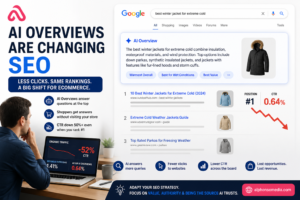
Data tracking click-through rates since AI Overviews rolled out shows organic CTR dropped from 1.41% to 0.64% for queries where an Overview appears. That is more than a 50% reduction in clicks, even when your page still ranks in position one underneath the summary block. You kept the ranking. You lost half the traffic.
For ecommerce stores that built their entire growth strategy around organic search, this is not a small problem. It is a structural one.
Why Ecommerce Stores Are Hit Harder Than Most
Not every industry feels this equally. Ecommerce stores operate in a search environment where buyers ask a lot of informational questions before they purchase. What is the best material for a winter jacket? How do I know if a sofa will fit my living room? Which protein powder is easiest on the stomach?
These are exactly the kinds of questions AI Overviews were built to answer. And they are the same questions ecommerce content teams have spent years creating blog posts and buying guides to capture.
That content still exists. It still ranks. But in many cases it no longer gets the click, because the Overview sitting above it already gave the reader enough to move on.
The bigger problem is what happens next. If a shopper gets their informational question answered by Google without visiting your store, you never get the chance to show them your product, build any familiarity with your brand, or pull them into your funnel. The journey that used to start on your blog now starts and ends on the search results page.
The Shift That Changes Everything: Being Cited vs Being Ranked
Here is the part most ecommerce SEO guides are not talking about yet.
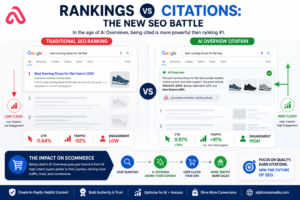
Getting cited inside an AI Overview now carries more weight than ranking in position one below it. Research shows that being cited in an Overview earns 35% more organic clicks and 91% more paid clicks compared to pages that rank traditionally underneath the block.
That changes the entire goal of ecommerce content. The question is no longer just “how do I rank for this keyword.” It is “how do I become the source Google trusts enough to pull into its AI-generated answer.”
The stores that figure this out first are going to have a significant advantage. The ones still optimizing purely for traditional rankings are going to keep watching their click-through rates shrink.
What Ecommerce Stores Need to Do Differently
The good news is that the fundamentals that get you cited in AI Overviews are the same fundamentals that produce genuinely good content. Google is pulling from sources it considers authoritative, specific, and trustworthy. That means thin content, generic product descriptions, and surface-level blog posts are even less viable than they were before.
What works now is content that goes deeper than the average page on the topic. Original data, real examples, specific answers to specific questions. Content that reads like it was written by someone who actually knows the subject, not someone filling a word count.
This is where a lot of ecommerce brands are making a mistake. Trying to scale content output with AI tools to cover more keywords faster. The result is more pages competing for citations they will never earn because the content is not meaningfully better than what already exists.
The stores winning citations are producing less content and investing more in each piece.
Where Paid Search Fits Into This New Reality
Here is something worth sitting with. As organic click-through rates fall because of AI Overviews, the relative value of paid search goes up. Ecommerce brands that previously relied almost entirely on SEO are now looking seriously at PPC to fill the gap.
But running Google Ads without a clear strategy in a competitive ecommerce space gets expensive fast. Working with a ppc marketing agency that understands ecommerce buyer intent is a very different investment than simply turning on campaigns and hoping the algorithm figures it out. The stores using ppc marketing services effectively right now are the ones pairing paid traffic with strong landing pages and clear conversion paths, not just sending ad clicks to a generic product category page.
The goal for most ecommerce businesses should be to reduce cost per lead over time by improving the quality of the pages paid traffic lands on, tightening audience targeting, and building enough organic authority that paid campaigns do not have to carry the entire load.
SEO and PPC are no longer separate strategies. In the AI Overview era they are part of the same answer to the same problem: how do you stay visible when the search results page itself is increasingly designed to keep people from clicking anywhere.
The Bottom Line
AI Overviews are not going away. Google has been clear that AI-generated summaries are a permanent part of how search works going forward. Ecommerce businesses that treat this as a temporary disruption and wait for things to go back to normal are going to find themselves in a difficult position.
The stores adapting now are rethinking what content is for. Not just rankings. Citations. Authority. Trust signals that work both for human readers and for the AI systems increasingly sitting between your content and your customer.
That requires better content, smarter distribution, and in many cases a paid search strategy that picks up where organic leaves off.
If your ecommerce store is navigating this shift and needs content that earns citations rather than just rankings, working with the right seo content writing agency makes a real difference. The best content writing services for ecommerce are not selling you word count. They are building the kind of content that gets referenced, trusted, and clicked in a search landscape that looks nothing like it did two years ago.