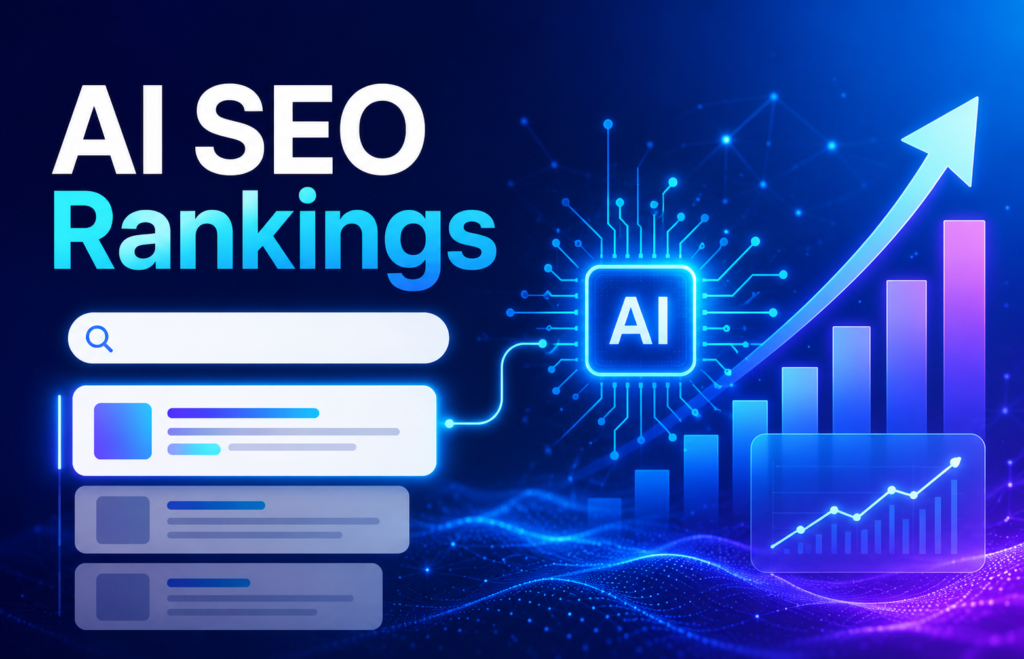
AI based SEO is transforming how businesses approach search visibility, content creation, technical optimization, and organic growth. With the increasing adoption of AI by search engines in terms of understanding users’ intentions, context, quality of content, and search behaviors, traditional practices are being modified. Organizations operating in the USA and other competitive markets need to adopt the best practices alongside the adoption of AI.
What Is AI Based SEO?
It is defined as the use of artificial intelligence and machine learning to analyze search data, interpret user intent, spot optimization possibilities, create, and improve content, and track performance in searches. The use of artificial intelligence does not require marketers to depend solely on manual search. The modern search engines are not only capable of analyzing single keywords but also understanding the connections between words, topics, entities, questions, and user intent. Therefore, the aspects of relevance, helpfulness, technical performance, and user experience gain more importance.
For companies, it can help to perform the research and make better-informed decisions in terms of strategy. Nevertheless, it is necessary to keep in mind that artificial intelligence should not substitute the strategic approach to the research.
How Artificial Intelligence Is Changing Search Rankings?
The way that search engines work when analyzing user queries has improved considerably. It is possible for a web page to include a particular keyword, yet be considered ineffective because it does not meet the user’s expectations or the user’s intent.
AI-powered tools assist the search engine in assessing content using several criteria, such as relevancy, context, quality, recency, topic connections, and the user experience. This implies that companies must concentrate on the creation of genuinely helpful web pages.
1. Search Intent Is Becoming More Important
AI is able to understand the intent behind the search rather than simply matching the exact words used in the search query. For instance, someone who is searching for “best digital marketing agency for small businesses in USA” is actually trying to compare, know the services, prices, experience, and so forth. Its techniques must now consider the intent behind the search. This means providing answers to their queries and educating them on certain concepts.
2. Content Quality and Relevance Matter More
These AI-based search systems can evaluate the content on a deeper contextual level. Content-rich pages with well-organized information, valuable insights, and relevancy will have better chances of ranking higher.
It is based on AI that can help to fill in content gaps, conduct topic research, cluster keywords, do competitor analysis, and give optimization tips. However, any kind of automatically generated content must be manually improved.
3. Search Ranking Factors Are Becoming More Connected
Factors influencing the rankings shouldn’t be considered independent points on the checklist. The aspects like technical accessibility, relevance of content, internal linking, user experience, authority, structured data, and user satisfaction might combine their impact on organic rankings.
AI-assisted strategies allows the marketers to see connections between those factors. One might conduct a content audit, finding out that one website has good articles but weak internal linking, and the other – good potential for traffic but no good match in terms of search intent.
How AI Can Help Businesses Improve Organic Rankings?
The goal of AI should not simply be to automate the tasks. Its real value comes from helping marketers understand data, prioritize opportunities, and make faster decisions.
1. Smarter Keyword and Topic Research
The algorithm can examine a huge amount of data from keywords and cluster related keywords on the basis of the user’s intent and topic. It will be useful in identifying primary topics, supporting questions, and long-tail keywords. It will not be necessary to create a new page for each and every keyword; the marketers will have an option to prepare content covering a number of related keywords.
2. Faster Content Optimization
AI has the capability to contrast current pages against their competitors in order to find out where there is room for improvement. This includes missing subtopics, unclear sections, repetitiveness, poor headings, and lack of proper internal links.
Thus, it becomes an integral part of content improvement. Instead of publishing a page and leaving it unchanged, companies have the chance to check its performance and then improve the content according to changes in search behavior.
3. Better Technical SEO Analysis
Some of the issues that can be identified by AI on a website include broken links, duplicated content, indexing issues, lack of metadata, bad internal link structures, and hard-to-index pages.
AI can greatly help to save time when searching for potential problems on big websites. Once the results have been reviewed by professionals, they will decide which problems need more attention.
AI Best Practices for SEO in the USA
It is common for organizations to work in very competitive search spaces when competing in the USA. Utilizing AI properly will demand balance and not total reliance on automation.
1. Combine AI With Human Expertise
The advantage of AI is its capability to process information fast; however, the system does not necessarily comprehend the corporate brand positioning, consumer issues, expertise within the industry, or the value proposition itself. SEO services specialists should utilize AI in research, analysis, and process automation, but not in decision-making.
2. Focus on Searcher Needs
Another one of the best practices of AI writing includes writing for humans first. A page should offer the answer, explain the topic well, and ensure that the information is easily accessible to the readers.
Businesses should never produce too much content via AI because of the ease of publication. The visibility in search engines relies on the quality and relevance of the content rather than its volume.
3. Use Data to Prioritize Opportunities
AI is able to detect hundreds of potential optimizations, but not all of them are worth focusing on at once. Companies need to consider such aspects as business value, searchability, ranking, competition, and conversion opportunities when selecting what needs to be done first. In some cases, optimizing a page’s position from the second page could bring more benefits than creating a completely new one.
Comprehensive SEO Services for AI Based SEO in the USA
Technical SEO services refers to SEO tactics that target crawling, indexing, website architecture, site speed, schema markup, mobile usability, and other technical aspects related to search engine bots, crawlers, and artificial intelligence search algorithms.
On Page SEO services are aimed at improving content, headings, metadata, internal linking structure, keywords, entities, and search intent. Basically, such SEO elements make a website more informative and optimized for search engines and AI search algorithms.
Off Page SEO services includes tactics related to backlinks, brand mentions, citations, digital PR, and other off-page techniques to improve a website’s authority and visibility in search results.
Enterprise SEO Services contain proven methods and approaches tailored for enterprises with a high amount of content and products, multiple service lines, various business units, and a large number of locations. Such SEO solutions cover global technical, content, and authority optimization to ensure overall improvement of an enterprise website.
Optimizing Website Searches With AI
But AI can also be applied by websites’ owners for purposes other than its optimization. Internal search statistics will give insight into what users are searching for on their website, what questions still need to be answered, and whether website navigation is confusing.
By combining internal search analysis with data from Google Search Console, as well as analytics and conversions, companies will be able to find content gaps and opportunities. It could become not only an external optimization of a website but also the process that will be focused on visitor experience after landing on a certain website. For USA-based companies, such an approach is particularly helpful when there is a vast product catalog, service pages, location pages, and even educational materials on the website.
AI Powered SEO Tools That Can Support Your Strategy
There is an ever-expanding set of tools that help with keyword research, content analysis, competitor research, technical audit, SERP analysis, internal linking, and performance tracking.
Still, each tool needs to be chosen based on the issue that it helps solve. If a site is content-based, it might require better tools for topic and content analysis. Meanwhile, an ecommerce site will benefit from a technical audit and product optimization.
It is more effective if the tool recommendation is paired with the information about the site itself and professional insight. The key is to make decisions better, not just give automated recommendations.
What Will SEO Look Like as AI Evolves?
It’s likely that the search will get more conversational, contextual, and personalized. The user may ask a longer question and receive a clear answer, instead of having only short keywords as an answer. This doesn’t mean that the concept of SEO disappears. The technical accessibility, proper content, proper information, links, website architecture, and good user experience will always remain important.
The point is that marketers should go beyond keywords. It will become more necessary to pay attention to entities, topics, intentions, interconnection of information, and usefulness of the website. Companies, which regularly track new changes, check their strategies, update the content, and use it properly, will have an advantage.
Key Takeaways for an AI-Driven SEO Strategy
- Understand intent: Build pages around what users actually want to accomplish.
- Strengthen content: Use it to identify gaps while adding original human expertise.
- Monitor technical SEO: Regularly identify indexing, linking, performance, and accessibility issues.
- Use AI strategically: Let automation handle repetitive analysis while humans make important decisions.
- Measure outcomes: Track rankings, organic traffic, engagement, leads, and conversions rather than relying on one metric.
How Alphonso Media Sets Itself Apart for AI Based SEO?
Alphonso Media uses a combination of artificial intelligence SEO software along with human skills to formulate strategies that help in generating sustainable search visibility and growth. Unlike using the only recommendation provided by the software, Alphonso Media utilizes insights from it along with keyword research, content strategy, technical SEO and performance analysis.
- AI SEO Strategy: Uses AI insights to find out the search opportunities and content needs according to individual businesses.
- AI + Human Expertise: Utilizes the software along with SEO experts to make sure that the strategy is accurate, relevant and business-centric.
- Data-Driven Optimization: Considers rankings, search data, competitors and performance of website to come up with practical optimization opportunities for better organic rankings.
- Intent-Based Content: Uses intent-based content creation rather than repeatedly using the same keywords.
- USA SEO Strategy: Formulates strategies for businesses aiming at competitive USA market in terms of SEO.
Final Thoughts
AI is impacting the way search engines read the contents and SEO practitioners perform SEO tasks. The greatest change lies in the shift from basic keyword optimization to more complex understanding of intent, context, relevance, and user satisfaction. Companies must perceive AI-based SEO strategies as an upgrade of the classic SEO instead of its substitute. With the right combination of AI analytics, good content, technical optimizations, expertise, and continuous improvements, companies can create a viable SEO strategy.
Regardless of whether a company is targeting customers in the whole of USA or specializing in a narrow niche, the aim remains the same – to create a website which will be easily understood by search engines and appreciated by users.
Frequently Asked Questions
It employs the concept of artificial intelligence for conducting keyword research, content analysis, technical audit, search intent analysis, and SEO decisions. It is used to speed up the process of data analysis and the overall SEO optimization process.
It assists search engines in better understanding the content relevance, context, intent, and its quality. Consequently, SEO ranking factors are becoming more integrated than standalone keyword and technical factors.
Yes. It allows finding content gaps, keyword opportunities, technical issues, internal links opportunities, and optimization priorities that will help improve the rankings of businesses in an organic manner, of course, if recommendations are evaluated properly and implemented strategically.
There are various tools depending on their purposes, some of which perform keyword research and content optimization, others conduct technical audits, competitive analysis, internal linking, performance analysis, and other tasks related to SEO of the websites.