Honestly, March 2026 was not a so good month for a lot of website owners.
One day your traffic looks fine, the next morning you open Google Search Console and something is clearly off. Rankings you had held for months, sometimes years, just quietly disappeared. If that happened to you, here is what actually went on and more importantly, what you should do about it.
Three Updates. Six Weeks. A Lot of Chaos.
Most people are only talking about the spam update, but the truth is Google dropped three separate updates between February and late March 2026. Each one targeted something different, and together they caused some of the biggest ranking swings the SEO world has seen in a while.
It started in February with a Discover-specific core update, which was a first. Google had never done a standalone update just for Discover before. It ran for about three weeks and was mainly about cutting clickbait-heavy content from Discover feeds and giving more visibility to sites that actually know what they are talking about.
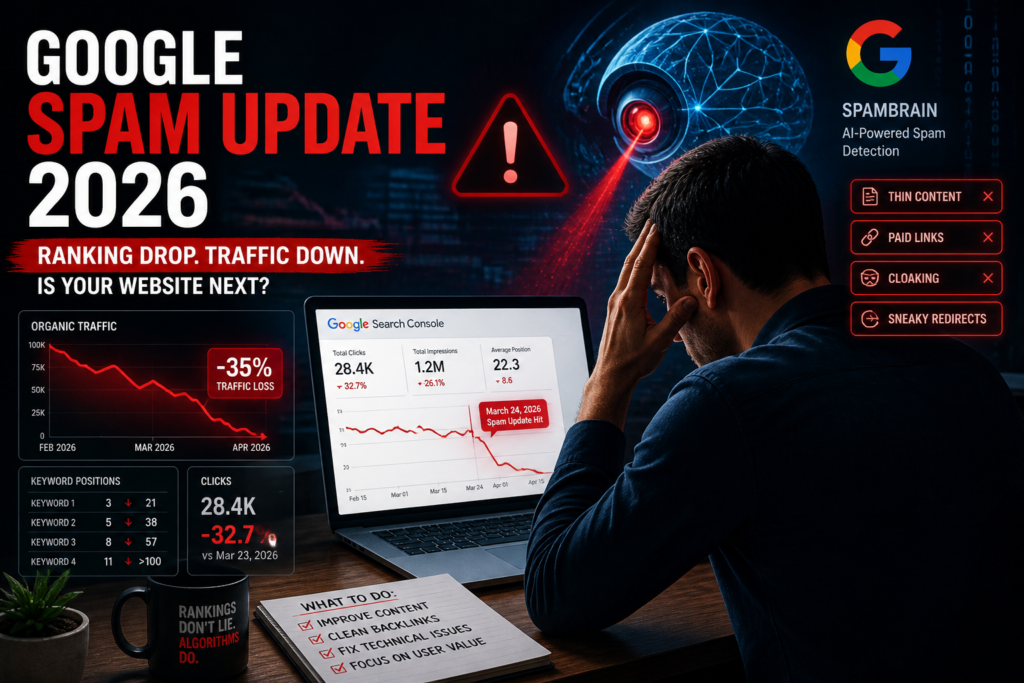
Then on March 24, the spam update hit. And it hit fast. Like, unusually fast. It was done in under 20 hours, which broke the record for the quickest spam update rollout Google has ever confirmed. No new spam categories were announced, no big blog post from Google, nothing dramatic. Just a quiet and very effective enforcement sweep powered by SpamBrain, Google’s AI spam detection system. Thin content, paid links, cloaking, sneaky redirects, all of it got caught in the net.
Two days after that, on March 27, the core update began. It took 12 days to fully roll out and by the time it was done, more than half of all websites had seen some kind of ranking movement. Some sites lost 20 to 35 percent of their organic traffic. That is not a small number for any business.
So What Was Google Actually Going After?
Here is the thing people get wrong about spam updates. They assume it is only shady websites that get hit. But plenty of legitimate businesses got caught too, because they had been relying on tactics that worked before but do not anymore.
The biggest culprits this time around were pretty consistent across every site that took a hit.
A lot of content might look good at first, but it doesn’t really say anything new, you could find the same stuff on plenty of other sites. No original data, no real perspective, no experience behind the words. Google’s systems have gotten really good at spotting the difference between content written to genuinely help someone and content written to show up in search results. If your pages fall into the second category, this update likely found them.
Mass-produced AI content also took a serious beating. And look, AI writing tools are not evil. The problem is when businesses use them to publish hundreds of pages with zero editorial input, zero expertise, and zero actual value. SpamBrain’s pattern recognition has improved dramatically and it is identifying that kind of content far more reliably now than it was even a year ago.
Backlinks were another major factor. If your rankings were being held up by links you paid for or links from completely irrelevant sites, those rankings are probably gone. And the painful part is that even if you clean everything up, you do not get those gains back. Google removes the value those links were providing and it does not restore it later.
How to Know If You Were Hit
Pull up Google Search Console and compare your traffic from before and after March 24. Look at your total clicks, impressions, and average position. If you see a sharp drop starting around that date, the spam update or core update is a very likely cause.
Also check under Security and Manual Actions. If there is a manual action listed, that means a real person at Google flagged your site for a policy violation. That is a separate and more serious situation than an algorithmic demotion, and it requires submitting a reconsideration request once you have cleaned things up.

What to Actually Do About It
Start with your content. Go through your lowest performing pages one by one and be honest with yourself. Ask if this page would actually help someone who is looking for answers. If the answer is no or even maybe, then it needs improvement.
Rewrite it with more depth, add your own insights, include real data, and make it genuinely useful. If the page cannot be improved, merge it into a stronger page and set up a 301 redirect instead of keeping weak content on your site.
Next, look at your backlinks. Not just how many you have but where they are coming from. A hundred links from irrelevant low-quality sites hurt more than they help at this point. Use the Disavow Tool for anything that looks suspicious and stop any link building practices that feel like cutting corners.
On the technical side, make sure your pages are loading quickly, especially on mobile. A Largest Contentful Paint score above 2.5 seconds is going to work against you. Compress your images, clean up your code, fix any crawl errors showing up in Search Console, and double-check that important pages are not accidentally blocked by noindex tags or robots.txt issues.
The Bigger Picture for Businesses Working with SEO Partners
These updates put a spotlight on something that does not get talked about enough. A lot of businesses had no idea what tactics were being used on their behalf until the rankings disappeared.
Whether you are working directly with an SEO agency in New York or using affordable SEO services from a smaller provider, you need to know exactly what is being done on your site. Ask about their link building process. Ask how they create content. Ask what they do when Google releases a major update. If you cannot get clear answers, that is a red flag worth taking seriously.
The same goes for agencies managing client campaigns through a white label SEOarrangement. If your upstream provider is cutting corners, your client’s site takes the hit and your agency’s reputation goes with it.
For businesses that needed to keep leads coming in during the March volatility, running PPC marketing services alongside organic recovery was genuinely the smart move. A good PPC marketing agency can keep your pipeline active while your SEO stabilizes, and it gives you data on what converts while you rebuild your organic presence. A lot of brands working with a reliable SEO agency in the USA were already set up for this kind of combined approach, which is why they weathered the update better than businesses relying entirely on organic traffic alone.
At Alphonso Media, we have always built campaigns around practices that hold up when Google gets stricter, not ones that collapse the moment enforcement improves. Whether you need a direct SEO service in NYC, a white label SEO partnership, or a broader digital strategy that covers both organic and paid, we work with you the same way regardless.
Comprehensive SEO Services for Google Spam Update Recovery
- Technical SEO
Technical SEO services helps identify and resolve crawling, indexing, website structure, page speed, schema, and other technical issues that may affect organic visibility after a Google update. - On Page SEO
On Page SEO focuses on improving headings, metadata, internal linking, keyword relevance, search intent, content structure, and page quality to make important pages more useful and search friendly. - Off Page SEO
Off Page SEO focuses on strengthening website authority through relevant backlinks, citations, brand mentions, and other external signals that can support long term search visibility. - Enterprise SEO Services
Enterprise SEO Services provide a scalable approach to managing technical SEO, content optimization, internal linking, authority building, and website quality across large websites with multiple pages, locations, or services. - SEO Content Writing Services
SEO Content Writing Services help businesses create original, useful, search optimized content that addresses user intent while demonstrating expertise and building trust. This includes SEO blogs, website content, service pages, landing pages, and other content assets designed to support sustainable organic visibility.
The Honest Bottom Line
Google is not going to stop updating. If anything, the pace is picking up and the detection systems are getting sharper every single time. The March 2026 updates were not a surprise if you were paying attention. They were just the next logical step in a direction Google has been moving for years.
Sites built on real expertise, real content, and clean SEO practices came through this fine. Sites that leaned on shortcuts are now doing damage control.
If you have not done a proper content and technical audit recently, now is genuinely the best time to do one. Do not wait for the next update to show you where the weaknesses are.