
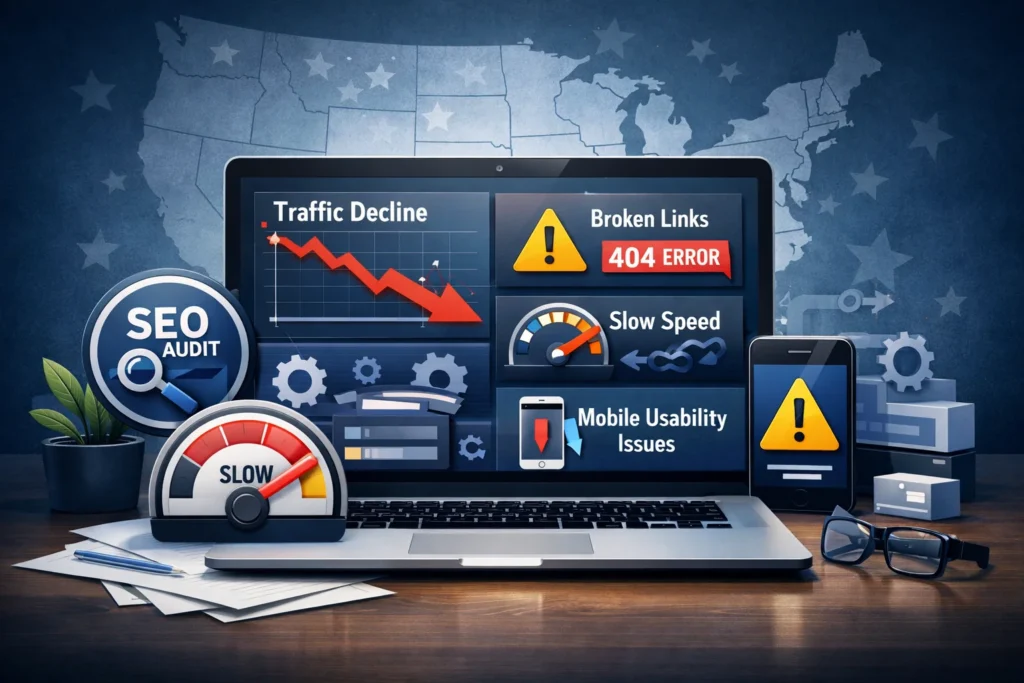
Technical SEO mistakes killing website traffic can remain unnoticed for months because a website may look perfectly fine to visitors while search engines struggle to crawl, index, or understand its pages. Businesses often focus on content, backlinks, and advertising when traffic declines, but technical problems can quietly prevent otherwise valuable pages from reaching potential customers.
From a technical point of view, it is especially vital for companies operating in the US to do well on search because the level of competition on search results is very high in a number of industries. The technical issues that can make a website lose visitors can have an impact on such aspects as visibility, user experience, conversion, and even discovery of pages by search engines.
Why Technical SEO Matters for Website Traffic
Technical SEO optimization services provide the groundwork on which the success of content and authority is based. Search engines must discover pages, crawl their resources, understand their interconnection, and decide which variants need to be displayed in search results. If any of these steps fail, even top-notch content cannot get organic traffic.
In such a case, a website may have great articles and good backlinks but poor search engine performance. Technical SEO mistakes that kill website traffic may include slow loading pages, broken links, wrong indexation settings, duplicated URLs, poor mobile experience, and bad site structure.
For businesses aiming at potential customers from different US cities or states, these problems may become particularly critical for websites with hundreds of pages related to services, locations, products, or information.
Technical SEO Content Writing Services USA help businesses create well-structured, search-optimized content that supports both technical SEO requirements and user search intent.
Slow Website Performance Can Reduce Search Visibility
Another problem is that many websites have slow page performance due to large images, too much JavaScript, bad coding, poorly optimized fonts, use of third-party scripts, and lack of sufficient hosting capacity to load the pages fast enough.
In this case, the slow website loading speed SEO influence has to be viewed in the context of conversion rate optimization. When people come to a web page either from the search engine results, via paid promotion, social media, and referrals, they need to have a good experience.
Businesses need to take a look at the areas that include image optimization, browser caching, effective coding, server speed, content delivery network, and use of third-party scripts. In order to improve speed, one does not have to get rid of all visuals and features on the web pages.
Broken Pages and Poor Redirects Can Waste Traffic
Another factor that could cause websites to lose traffic is broken links or obsolete URLs. As a result of product obsolescence, page renaming, category restructuring, or website redesign, URLs tend to become outdated for a website. In case these URLs continue to receive backlinks and search traffic and return an error message, their value will be wasted.
A properly planned redirection system for 404 pages can help to determine the URLs to be redirected to new pages and the URLs to be made unavailable. Not all URLs must be redirected. It may lead to a bad user experience and will also waste the value of the original page. The company must identify the broken internal links, obsolete external links, redirected chains, and other pages that return other than expected status code. It will make it easier to use the website.
Two Technical Areas That Deserve Priority
- Crawl and indexing control: Review robots.txt directives, noindex tags, XML sitemaps, canonical signals, status codes, and indexability to ensure valuable pages are accessible to search engines. A page cannot generate organic traffic if search engines are prevented from discovering or indexing it.
- Website structure and usability: Improve internal linking, URL organization, mobile responsiveness, HTTPS implementation, navigation, and page relationships so visitors and search engines can move through the site efficiently.
Mobile Experience Is No Longer Optional
A site that works efficiently for the desktop interface but causes issues for smartphones can face the risk of losing search visibility and conversions. It is essential to keep in mind that users frequently use mobile devices to access and interact with websites; therefore, businesses should ensure usability of layout, navigation, forms, buttons, images, and other elements of sites for smaller devices.
Common mobile-first indexing pitfalls include the lack of crucial content in mobile versions, buttons that are hard to click, horizontal scrolling, intrusive elements, and significant differences between content of desktop and mobile versions. Businesses should check the real mobile version of crucial pages and not assume that responsive themes will fix all issues.
The process of mobile optimization also requires considering conversion factors. If a customer finds a certain service page via search but fails to fill out a form or contact the business on a mobile device, then he/she will not become a lead.
Duplicate URLs Can Split Ranking Signals
Duplicate or near-duplicate pages can lead to additional complications. The most common situations where such complications happen include variations of products, tracking parameters, filter categories, various URLs for the same page, printer-friendly page versions, and location duplicate content.
Canonical tag duplication content correction will allow you to specify which URL is considered the primary one among multiple URLs representing similar content. Nevertheless, it’s essential to understand that canonical tags are not a cure for all types of duplication content problems.
Companies must consider reasons for the presence of duplicate URLs and their necessity. It may be worth considering such solutions as redirections, handling of parameters, better internal linking, consolidation of content, or removal of unnecessary pages.
Robots.txt and Noindex Errors Can Hide Important Pages
However, indexing instructions are very strong tools that must be used responsibly because one misconfigured robots.txt file may lead to the situation when access to valuable resources will be limited for crawlers. Moreover, one incorrectly set noindex instruction can lead to such situation that valuable resources will not be indexed by the search engine at all.
All these issues typically appear due to website migrations, development or plugins updates, re-design or technical deployment. Each time you conduct any changes on your website, it is crucial to perform an indexing check to see that all valuable pages can be accessed and indexed. Moreover, XML sitemap must include valuable URLs, not those that have been redirected, blocked or are just marked as noindex.
Weak Internal Linking Can Limit Page Discovery
Internal links help users navigate a website and help search engines understand how pages relate to each other. When important pages are buried several clicks deep or receive almost no internal links, they may not receive sufficient attention within the site’s architecture. A strong internal linking system should connect related topics naturally. Service pages can link to relevant guides, location pages can connect to useful regional information, and blog articles can point users toward relevant commercial pages. Internal linking should serve visitors first. Adding large numbers of irrelevant links simply to manipulate signals can make pages harder to read and navigate.
Poor URL Structures Create Unnecessary Complexity
Short, descriptive URLs are generally easier for users and search engines to understand than URLs containing unnecessary parameters, random characters, or complicated folder structures. When websites grow quickly, inconsistent URL naming can become a significant maintenance issue. Businesses should establish a logical structure before publishing large numbers of pages, particularly when creating location pages, service categories, product collections, or content hubs. A clean URL system also makes website migrations and future content management easier. Consistency is more important than forcing every URL into an identical pattern.
HTTPS and Security Should Be Checked
Web security is yet another aspect that should be taken into account from a technical standpoint. Businesses should make sure that their main domain uses HTTPS correctly and that all HTTP domains redirect properly. Issues with mixed content should also be fixed if secure pages are loading resources through an insecure connection.
HTTPS itself will not change search results, but it creates a safer browsing experience, especially for websites that collect user information.
Large Websites Need Regular Technical Reviews
Technical problems become harder to manage as websites grow. A company with dozens of pages may be able to identify problems manually, but websites containing hundreds or thousands of URLs require a structured review process.
An SEO audit for US businesses should examine crawlability, indexation, page performance, redirects, duplicate URLs, mobile usability, internal linking, structured data, sitemap health, security, and other technical elements relevant to the website.
The audit should not simply produce a list of errors. Each issue should be evaluated according to its potential impact, affected URLs, business importance, and implementation difficulty. This allows teams to prioritize problems instead of attempting to fix everything simultaneously.
How to Fix Technical SEO Problems Without Creating New Ones
Website Technical issues optimization strategy need to be systematic. The first step for businesses is to understand the exact nature of the problem, decide on which pages the problem affects, and establish if the problem is pervasive or limited. After that, changes should be tested before implementation across the entire website.
For instance, modification of URLs across many pages without linking old URLs with new URLs will result in the creation of many dead links. Also, changes made to robots.txt policies without proper checking can lead to the blocking of search engines to crawl valuable information.
There should be a system where businesses keep records of the changes made and monitor the signals after implementation.
How Alphonso Media Can Help
Alphonso Media helps businesses identify and address technical problems that may interfere with organic visibility and website performance. Its SEO services can support businesses that need ongoing technical monitoring rather than a one-time review.
- Technical SEO analysis: Reviews crawlability, indexation, site structure, redirects, performance, and other technical areas that can influence search visibility.
- Website issue prioritization: Helps businesses distinguish critical problems from lower-impact warnings so resources can be directed toward meaningful improvements.
- On-page and technical optimization: Supports improvements to website structure, internal linking, metadata, content organization, and other optimization areas.
- Ongoing SEO monitoring: Tracks website health and search performance so emerging technical problems can be identified before they significantly affect traffic.
Why Technical SEO Should Be an Ongoing Process
Technical optimization should not end after a website passes a single audit. Websites change constantly as businesses publish content, add features, update platforms, modify templates, install plugins, and create new landing pages.
Each change can introduce new technical problems. A redesign may create broken redirects, a plugin can add unnecessary scripts, a developer can accidentally modify indexing directives, or a content team can create duplicate URLs.
Regular monitoring helps businesses identify these issues earlier. Technical SEO mistakes killing website traffic are much easier to address when they are detected before hundreds of pages are affected.
Final Thoughts
Technical SEO mistakes are often less visible than content or design problems, but their impact can be substantial. A website needs to be accessible, crawlable, indexable, fast, mobile-friendly, secure, and logically structured before its content can reach its full organic potential.
Businesses should therefore treat technical SEO as an ongoing part of website management rather than a one-time task. Regular audits, careful implementation, performance monitoring, and structured maintenance can help protect organic visibility while creating a better experience for visitors.
When technical foundations are strong, content and authority-building efforts have a better environment in which to perform. Addressing technical problems systematically can help businesses protect existing traffic, improve search visibility, and create a more reliable foundation for future growth.
Frequently Asked Questions
The slow website loading speed SEO impact is not limited only to the negative user experience but also creates engagement issues and prevents businesses from offering a fast, accessible experience across all types of devices. Website performance needs to be considered along with other technical and conversion-related aspects.
Businesses need to find out why some of the URLs are displaying such errors and see if they have any alternative URLs. In this case, proper 404 page redirection will help keep working URLs, while others will get the necessary status.
A technical SEO audit for US companies allows identifying the crawlability, indexing, performance, mobile, redirect, duplicate content, security, and structure issues that may negatively impact organic search.
Among the mobile-first indexing mistakes are the following: hiding crucial information on mobile, building poor mobile navigation, using hard-to-tap elements, offering different essential content for the version and inability to make crucial pages available for smartphones.