
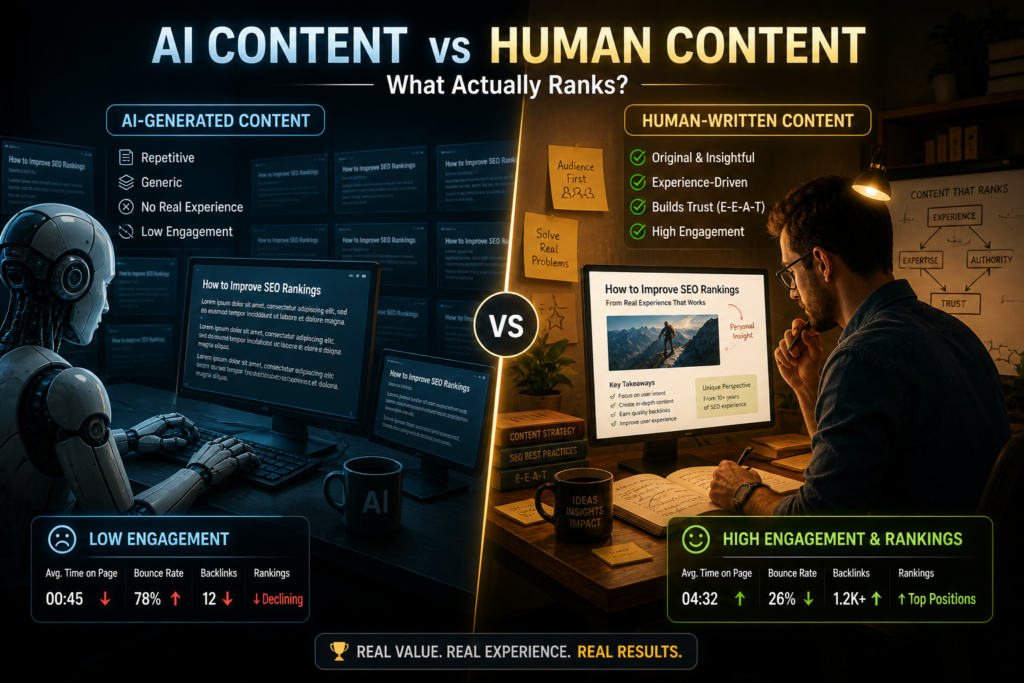
Here is something most marketing blogs will not tell you: the AI content debate is not really about AI.
It is about whether your content gives someone a reason to stay on the page. Always has been. The tool used to write it is almost beside the point, except that in practice, one approach produces content people actually read and the other mostly produces content that looks like content.
That distinction is costing a lot of businesses their rankings right now.
Nobody Talks About What Happens Three Months Later
When businesses switch to AI content, the early results are often fine. Pages get indexed. Some pick up impressions. Traffic ticks up a little. So the experiment gets declared a success and the volume ramps up.
Then the core update hits.
What Google’s algorithm has gotten genuinely good at is measuring whether users got what they came for. Not whether the page had the right keywords or the right word count. Whether the person who clicked actually stuck around, scrolled, and left satisfied. AI content at scale tends to fail that test because it is, almost by definition, a recombination of what already exists. It cannot add to the conversation. It can only rearrange it.
A Semrush study that looked at 42,000 blog posts found human-written content in the top Google position 80% of the time. AI content was there 9% of the time. An 8x gap is not a rounding error. It reflects something real about how Google evaluates pages when it has enough behavioral data to make a call.
The Part AI Cannot Fake
There is a specific thing human writers do that does not get talked about enough.
They get things wrong and then correct themselves mid-paragraph. They go on a tangent that turns out to be the most useful part of the piece. They write a sentence, hate it, rewrite it three times, and land on something that actually sounds like a person. That messiness is not a flaw. It is what makes writing feel like it came from someone who was genuinely working through a problem rather than generating a plausible response to a prompt.
Google calls it E-E-A-T: Experience, Expertise, Authoritativeness, Trustworthiness. The first E, experience, is the one AI cannot touch. You cannot simulate having done the thing. Readers know the difference even when they cannot articulate why. They stay on pages written from real experience and they leave pages that feel hollow, and those behavioral signals feed directly back into rankings.
This is why a good SEO content writing service is genuinely different from a content mill with an AI subscription. The writers know the subject. They have opinions about it. Those opinions make the writing useful in a way that no prompt engineering can replicate.

Why Backlinks Make the Gap Worse
Most people focus on on-page quality when they think about ranking. The backlink problem with AI content does not get enough attention.
Editorial backlinks, the kind that actually move rankings, come from other writers and editors choosing to reference your work because it said something worth pointing to. AI content almost never earns those. Not because other sites detect it as AI, but because there is nothing in it to cite. No original finding, no perspective that challenges something, no data that came from actual research. It is just a competent arrangement of existing ideas.
Human-written content from a skilled website content writing service earns links over time because it gives people something to reference. That compounding effect is enormous. Pages that earn links gain authority. Authority means Google trusts them with more rankings. More rankings mean more traffic. The gap between AI content and human content does not stay the same size. It grows.
Where AI Actually Fits
None of this means AI has no place in content production. That would be an overcorrection.
Smart teams at some of the best content writing services use AI for the parts of the process where it genuinely helps. Pulling together research from multiple sources quickly. Generating a rough outline to react to. Checking whether a draft covers the sub-questions a reader might have. That kind of use speeds up the human writer without replacing the judgment that makes the work good.
The problem is not AI assistance. The problem is AI replacement. Generating a draft and publishing it with light edits produces content that is technically complete and practically useless for building any long-term SEO equity.
If you look at content writing agencies in USA that are actually delivering ranking results for clients, they all have one thing in common. Writers are making the decisions. AI might be in the workflow somewhere, but a person is responsible for whether the final piece is worth reading.
What to Ask Before You Hire Anyone
If you are evaluating content partners, three questions cut through most of the noise.
Who is actually writing? Not the pitch deck answer. The real answer. Is it a trained writer with subject knowledge or is it a prompt and a review?
What happens after the first draft? Is there an editorial process? Does someone read this as a reader, not just a proofreader?
Can you show me something that ranks? Not a screenshot of impressions from the first two weeks. A page that has held a position through at least one algorithm update.
SEO content writing agencies that cannot answer those questions clearly are probably selling volume. Volume is easy to measure. It is also easy to produce. What is hard to produce, and what actually builds a site’s organic presence over time, is content that earns its ranking by being genuinely better than everything else on the topic.
So What Actually Ranks?
Writing that knows something. Writing that has a point of view. Writing where a real person made judgment calls about what to include, what to cut, and how to say the hard thing in a way that lands.
That is not a description of what AI produces on its own. It is a description of what experienced writers produce when they are given a clear brief, enough time, and editorial support.
At Alphonso Media, that is exactly how we work. Our SEO content writing agency puts real writers on every piece, people who understand your industry and understand how search actually works. The result is content that ranks, holds its position, and does the job you hired it to do.