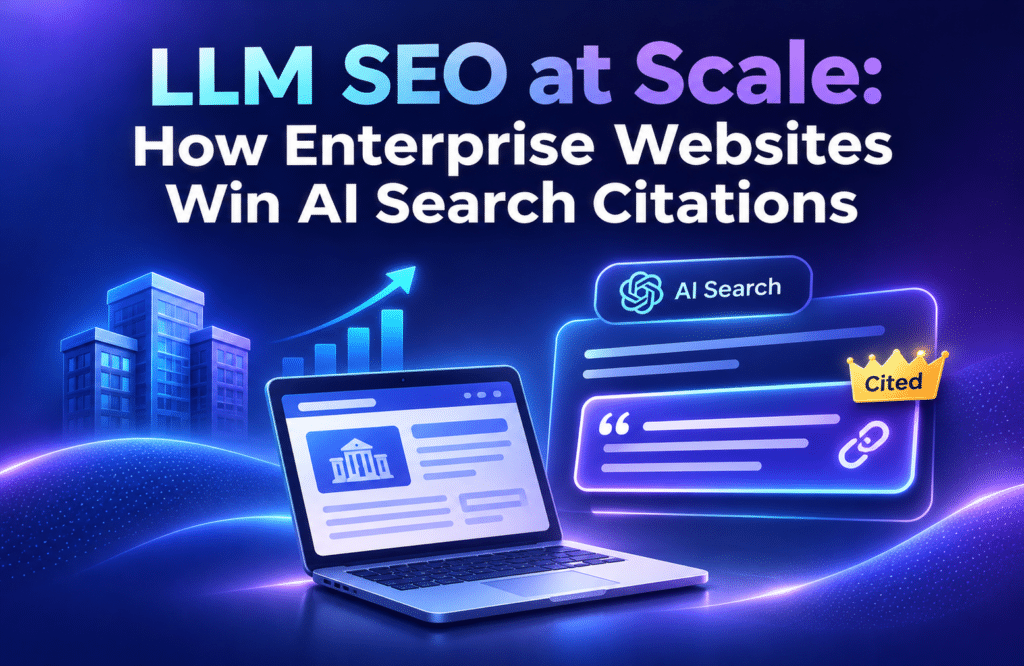
What Is LLM SEO and Why Does It Matter for Enterprise Websites?
Large language model (LLM) SEO means optimising web content and information so that it can be understood, searched, interpreted, and possibly cited by AI search platforms. In comparison to conventional SEO, LLM SEO also takes into account how the information will be found and interpreted using conversational AI. AI may draw upon current knowledge, search the web, or do a combination of both to create accurate searches. This is very important for enterprise content. If enterprise websites have large volumes of information relating to various categories, departments, locations, and products, not optimising this consistently could mean that the content within the websites is not being found or interpreted properly by search engines and AI retrieval. Within enterprise LLM SEO, we aim to make content accessible, reliable, and easy to understand. This is done by improving content formatting, improving entity connections, ensuring factual accuracy, and creating authority within specific topics to answer targeted questions for customers. LLM SEO can help improve brand awareness in the research phase. If someone is researching which service providers to choose, looking to understand a problem within an industry, or researching what appropriate solutions exist within a business, they may turn to an AI platform. If useful information in relation to these queries is published on the enterprise websites, there is an opportunity for this content to be included in the list of information sources used by AI search platforms. Having strong organic SEO is still very important here. As the content must be easily found (crawlable), of a high quality, and discoverable in order to gain good visibility in searches.How Enterprise Websites Can Build an LLM SEO Strategy at Scale
Improving content on hundreds or thousands of web pages requires structure. Improving content without strategy in place may cause inconsistency, duplication and issues. To allow large scale content optimisation in enterprise environments, consistent processes are needed to ensure quality content.1. Build a Structured Content and Topic Architecture
A well-structured content architecture will enable search engines (and AI systems) to understand relevant relationships between web pages. In an enterprise context, there may be a lot of overlap within your service pages, products, industry content and blogs. Creating clear topic clusters will help to build context between web pages, and make it easier for people to find the right information. List out the main business areas, services, products, industry sectors and questions which need to be covered. Create topic clusters in relation to these areas, with relevant sub topics. Within each important topic you should create ‘hub’ pages, with supporting web pages which elaborate on specific points within that topic. An enterprise selling CRM software may create content about Customer Relationship Management, Sales Automation, Customer Analytics, and Integration. Within each topic, create resources with details on functionality, applications, process of implementation and benefits to the business. Including hyperlinks to and from pages will allow users and search engines to understand the relationship. To ensure a scalable content architecture, perform regular audits. This will allow you to remove obsolete pages, reduce content on similar topics, fix any broken internal links and find gaps in content. This means that as your website grows with the business, large amounts of content will remain manageable.2. Create Content That Answers Specific Questions
Ensure that content is optimised for question based searches using AI. Ensure it addresses specific questions that your customers may have. Consider how a potential customer may be researching solutions, comparing businesses, evaluating different options and resolving common issues. For instance, if someone is looking for an enterprise CRM solution, they may search “Which CRM platform is suitable for a business operating across multiple countries?” If a resource answers this question effectively by outlining key features, considerations around multi-national deployment, integration, security requirements and scalability within this solution then it will be very useful. Including concise and thorough information means it is more useful to the reader and can be interpreted easily by search engines. Within enterprise content, descriptive subheadings, clear explanations, correct supporting information and consistent terms should be used. If content is discussing complex information, make sure it is written in simple language, but include all of the key information. Including original research, useful information, accurate data and relevant examples can make enterprise content stand out. This means that it is not just generic information that can be found in many places, but useful content that provides value.3. Strengthen Entity Optimisation and Structured Data
This allows search engines to understand entities better. This is particularly useful for enterprise sites as they are likely to be active in multiple sectors and/or regions. Schema markup can give further information on your content. Different schema types could be used depending on the content of the page. For example, Organisation, Product, Service, Article and BreadcrumbList. Ensure that any schema markup used is accurate and relevant to what users can see on your page. Schema shouldn’t be made up or contain unnecessary properties. Accuracy is key to this. The brand name, product descriptions, services provided, authors, business location and contact details should be consistent across your site and other external sources. Whilst having schema markup doesn’t guarantee citations from AI search engines, it can improve understanding for search engines.4. Improve Technical Accessibility Across Large Websites
Technical SEO health optimization services help identify and resolve website issues affecting crawlability, indexability, site performance, and search visibility. Large websites can have several technical issues which may prevent content being found and crawled. These may include complex site architecture, duplicated URLs, incorrect canonical tags, redirect loops, and old sitemaps. To ensure quality content is visible, businesses should regularly check their robots.txt, internal links, sitemap coverage, page status codes, mobile performance and rendering performance. As different AI platforms will use different crawlers, enterprise teams should take a look at provided documentation to understand how crawlers are working for their specific provider. They should consider changes to robots.txt and firewalls to best support the AI in question. Just because your content is visible to one AI crawler does not mean it will be visible on other platforms. Monitoring technical SEO within an enterprise environment should be an ongoing process, rather than a one-off audit of the site.How to Get Cited by ChatGPT and Perplexity
Citations in ChatGPT and Perplexity will allow your business to appear in the correct search results. Depending on the search query, information can be pulled from online sources and displayed with citations. While there is no guaranteed way to achieve citations, each platform will have its own process of pulling information, selecting sources and creating answers. To increase your chances of appearing, you should include accurate, clear, and relevant information. Ensure your content aligns with user search intent, demonstrates expert knowledge, and includes enough evidence to support key points. Implementing effective On Page search engine optimization strategies is equally important to improve content relevance, strengthen page structure, and make important pages on your website easier for search systems to discover and understand. If you are providing enterprise Cyber Security solutions to B2B customers, detailed content around assessment, threat detection, regulation, implementation, and challenges specific to certain industries can be created. Through these resources, you provide very useful information at various points in users’ research journeys and increase the potential of relevant pages being found. The following practices can strengthen an enterprise website’s AI citation potential:- Publish Original Information: Develop content supported by industry research, practical insights, verified statistics, and genuine business experience.
- Establish Brand Expertise: Maintain detailed service pages, expert articles, case studies, and accurate company information.
- Provide Direct Answers: Address common customer questions through clear explanations and descriptive headings.
- Strengthen Internal Linking: Connect relevant resources so that important topics and supporting information form a coherent content ecosystem.
- Maintain External Brand Consistency: Ensure business information and product descriptions remain accurate across authoritative third-party platforms.
- Update Important Content: Review outdated statistics, service details, industry developments, and technical information regularly.
How to Track AI Search Citations and Measure Performance
Beyond organic rankings, impressions, clicks and conversions, it is important to measure performance in an enterprise LLM SEO strategy. Even if a user doesn’t click through to your website, they could still be exposed to your brand via AI responses. This means measuring AI citations helps marketing teams understand whether their content is being surfaced in appropriate AI responses, and subsequently increasing brand awareness. To effectively measure performance in enterprise LLM SEO, consider implementing a mix of AI visibility, website metrics, server logs and repeated prompts. Select key business and information focussed queries and run these multiple times across various AI platforms. Note if the brand/website is mentioned within the AI response.| Performance Metric | What It Measures |
| AI Citation Frequency | How often website URLs appear as sources in AI-generated responses |
| Brand Mention Share | How frequently a brand is mentioned compared with competitors |
| Cited URL Distribution | Which website pages receive AI citations |
| AI Referral Traffic | Visits arriving from identifiable AI platforms |
| AI Search Visibility | Brand presence across selected conversational search queries |
| Conversion Performance | Leads, enquiries, and sales associated with AI referral journeys |
Common LLM SEO Challenges for Large Enterprise Websites
Large scaled LLM SEO can be challenging within large digital ecosystems. Large enterprises will have many teams, departments and platforms to manage, meaning consistent quality, technical quality and brand messaging can be difficult to maintain. Even within large content repositories, without a centralised approach, accurate and findable content may be difficult to achieve. Content duplication can be an issue. Information duplicated across multiple departments can lead to redundant content, where multiple pages provide little added value. A content audit and consolidation will help to identify this issue, ensuring that each page has a clear purpose. Inconsistency in brand messaging can also be an issue. Product information, service descriptions and capabilities may differ across different areas of the site. Within large enterprises, content management and technical management can become complex. To maintain consistency in content quality, large content production teams must follow consistent content guidelines. Technical concerns must also be considered to ensure changes made to the website do not negatively impact crawling, indexing and internal linking. Understanding visibility of AI content can also be challenging as different platforms offer varying levels of visibility data and citations. To overcome these challenges, collaboration between SEO experts, content teams, developers and business stakeholders is key. Having a documented optimisation process ensures consistency in improvements as the website grows. Regular audits and performance reviews allow large enterprises to be adaptive in their strategy, in line with changes to AI search tools and customer expectations.How Alphonso Media Helps Enterprises Scale LLM SEO
To successfully integrate AI search into your business, you will need to implement technical SEO practices, develop content, optimise entities and monitor performance throughout. By working with an expert LLM SEO company, businesses can create structured optimisation strategies. Alphonso Media offers SEO optimization services, so that businesses can improve their visibility within digital platforms. Their LLM SEO service allows businesses to improve in AI discovery, while also improving organic search. This means that content on enterprise sites makes it easier for searchers and potential customers to find useful information. By combining expert SEO knowledge, optimised content and technical improvements Alphonso Media can help businesses gain long term visibility in search engines. The goal is to create useful digital content, making it easier for customers to discover brands, increasing credibility and driving tangible business growth. Alphonso Media combine traditional SEO methods with the new requirements of AI searches to allow enterprises to position themselves well within evolving search environments. Benefits of Alphonso Media’s Services:- Enterprise SEO Strategy: Structured optimisation strategies for websites with large volumes of pages and varied business types.
- AI Search Optimisation: Improving readability, relevance, organisation and question-based content.
- SEO Technical Audit: Identifying technical issues with crawlability, indexation, internal linking, rendering and site structure.
- Entity and Schema Optimisation: Enhancing context and adding appropriate schema tagging.
- AI Visibility Analysis: Monitoring brand mentions, opportunities for citation, competitor visibility and performance from AI referral sources.
- Content Strategy: Ensuring content has clear guidelines in order to guarantee quality and accuracy, particularly on large websites.
Frequently Asked Questions
What is LLM SEO?
LLM SEO refers to optimising content, websites, and data so that they are easily understood and found by large language models and AI search engines.
How can large websites be found in ChatGPT and Perplexity?
Large websites can be found by AI search engines if they contain high quality content. It is useful to have grouped topics, optimise technical performance, ensure accurate brand information is present, and provide concise answers to relevant questions asked by users.
Can using schema mark-up increase AI search citations?
Using schema mark-up means that structured data can be understood by search engines, however there is no guarantee of increased AI citations.
How can businesses measure AI search citations?
AI citations can be measured using multiple prompts, AI visibility tools, brand mentions, and tracking URLs. Server logs and referral traffic can also be used. By analysing results over time, visibility trends can be identified.
Why should an enterprise consider LLM SEO services?
LLM SEO should be considered by an enterprise within their marketing strategy as it will increase visibility on AI searches, increase brand authority and allow an organisation to efficiently structure a large amount of content on their website. It also means marketing strategies can be adapted to the changing search behaviour of customers.